
During each summer, when teams are looking to enhance their rosters, a common filter is often applied: Can this player help us win a playoff game?
Let’s face it. When dealing with exceptions or minimum deals, it’s unlikely that you’ll come across a player who can elevate your team from a play-in contender to a championship contender.
Therefore, the focus is usually on whether a particular player has the capability to step up when it matters most and contribute to winning a game in the postseason. After all, one playoff victory accounts for 25% of the journey to advance to the next round.
At times, these impactful players may even be earlier draft picks who haven’t quite reached star status.
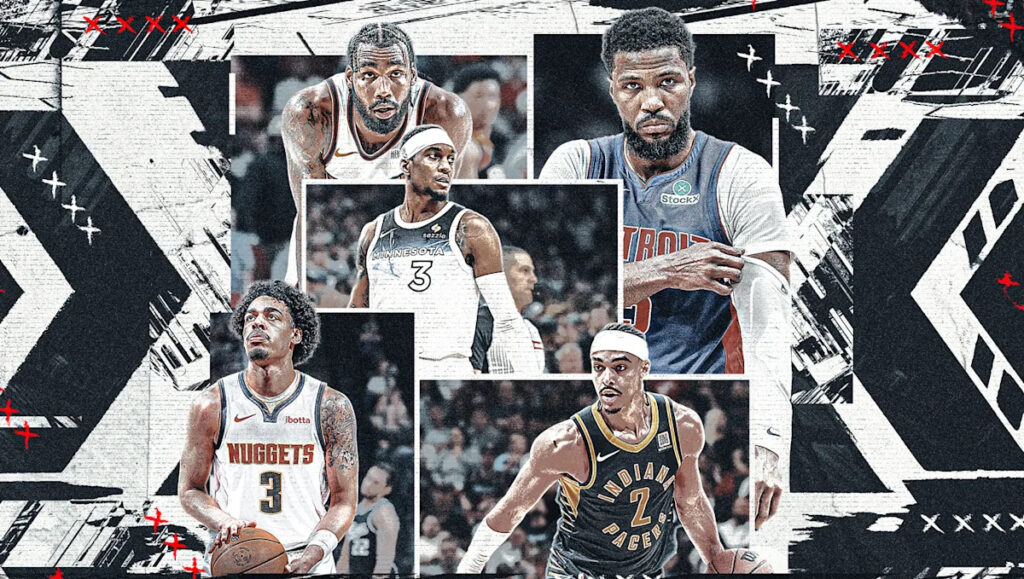
For the initial round of the 2025 NBA playoffs, here are five players who could make a difference:
(Joseph Raines/Yahoo sports illustration)
Malik Beasley, Detroit Pistons
It may seem like an obvious choice, but that doesn’t diminish the truth behind the selection.
When you have a player like Beasley who can stretch the floor as effectively as he does — sinking 319 3-pointers this season at a 41.6% clip — you can’t help but anticipate a timely outburst.
Beasley, who spent the season playing alongside star guard Cade Cunningham, enters the playoffs on the back of consecutive games with seven made threes. In the postseason, with defenses honing in on stars unlike in the regular season, Cunningham will need to move the ball faster and more frequently, both of which could benefit Beasley.
Of course, whether he delivers those shots remains to be seen. However, the 6-foot-4 shooting guard stands a good chance of swinging a game, or even multiple games, with his outside shooting against the Knicks.
It might feel like a cheat to highlight a player averaging 16.3 points, but considering that 957 of Beasley’s 1,336 points in the regular season came from beyond the arc, it’s clear that his proficiency lies in long-range scoring.
Moreover, with New York’s Josh Hart and Mikal Bridges shadowing him, Beasley will need to capitalize on the opportunities he receives.
Jaden McDaniels, Minnesota Timberwolves
For years, McDaniels was hesitant to shoot, often passing up open shots and driving lanes.
This season, with Karl-Anthony Towns absent and the offense in need of a boost, the 24-year-old began taking more shots and exploring an expanded scoring role.
In February, McDaniels’ investment paid off as he averaged 18.5 points and 8.4 rebounds in 13 games. While his efficiency wasn’t stellar, his willingness to shoot is crucial.
The focus isn’t solely on his offense, as McDaniels excels defensively. However, if he can become more assertive in shooting and add a touch more aggression to his offensive game, that would be a huge asset for head coach Chris Finch, especially against a Lakers team with multiple players capable of dropping 30-plus points any given night.
McDaniels is likely to defend LeBron James, Austin Reaves, and Luka Dončić, a challenging task. There’s a scenario where Finch may require his forward to expend more energy on defense against that trio than on offense. Yet, that could be a misstep, leaving too much scoring responsibility on Anthony Edwards, Julius Randle, and Naz Reid.
For the Wolves to have a solid footing in this series, McDaniels must be engaged on both ends of the court and not shy away from opportunities. If he’s confident and willing to take shots, he could turn the tide in Minnesota’s favor in multiple games.
Julian Strawther, Denver Nuggets
Amidst the chaos of head coach Mike Malone’s mid-season firing and general manager Calvin Booth’s departure, the Nuggets still have playoff basketball to contend with.
All season long, the Nuggets have struggled with inconsistency in their secondary rotation, be it offensively, defensively, or in terms of overall cohesion.
Strawther, a second-year wing, has seen a decrease in minutes recently, but interim head coach David Adelman has good reason to utilize him against the Los Angeles Clippers.
Standing at 6-7, 210 pounds, Strawther possesses legitimate size. He has a scoring touch, including an outside shot, and the ability to drive to the basket.
To make Strawther an X-factor, he needs to play off Nikola Jokić more, essentially mirroring the role of Michael Porter Jr. by reacting to Jokić’s movements to find open spaces.
It’s a tall order for someone who only took 14.2% of his shots near the rim this season, but given Denver’s need for bench scoring and Strawther’s scoring instincts, there’s no time to waste. He must embrace a larger, more influential role immediately. Sink or swim.
Andrew Nembhard, Indiana Pacers
It almost feels unfair to include a Pacer on this list because the entire rotation consistently performs well within their roles.
However, in the playoffs, simply being consistent won’t lead to a championship. This holds true for the Pacers as well, especially for Nembhard, who has always been a player willing to accept his role and has likely sacrificed numerous shots over his first three years in the league.
For the Pacers to break through, Nembhard must break out of his modest production trend. His 10 points and five assists in 28.9 minutes per game have been serviceable, but Indiana will need him to increase his shot creation to open up the floor for Tyrese Haliburton, Pascal Siakam, Myles Turner, and Bennedict Mathurin, the team’s top four scorers.
The issue isn’t a lack of scoring for the Pacers. It’s more about their current leading scorers being somewhat predictable. Turner will rely on pick-and-pop 3-pointers and scoring near the rim. Haliburton will generate looks from the outside, while Siakam operates from the elbows.
While effective, in a playoff series where adjustments are made game by game, the Pacers need to introduce something new and diversify their offense. This is where Nembhard, actively looking for his shot, can draw attention and leverage his scoring threat to enhance his playmaking.
Transforming Nembhard into a more scoring-oriented version of himself will make the Pacers a much harder team to figure out.
Tari Eason, Houston Rockets
In the playoffs, especially for a team struggling to generate consistent perimeter offense, sometimes you need a spark plug to ignite the game and step out of the way.
Houston has two such players in Eason and Amen Thompson, but Thompson is already a known entity, while Eason still catches opponents off guard.
The 6-8 combo forward is incredibly athletic, a forceful defender, a reliable rebounder, and fearless in transition, both with and without the ball.
Allowing Eason to play to his aggressive style, by pushing the ball after turnovers, infusing energy into the game, and constantly pressuring the defense, could help offset Houston’s shooting deficiencies and maintain the emotional edge.
Designing plays to give the 23-year-old opportunities to attack the rim, even at the expense of more stable half-court options, could be a worthwhile investment, especially if he can finish near the basket (67.8% at-rim efficiency during the season) and force defenses to collapse.
Eason has always been a per-minute statistical standout, and now might be the perfect time for Houston to expand his role and unleash his potential.