
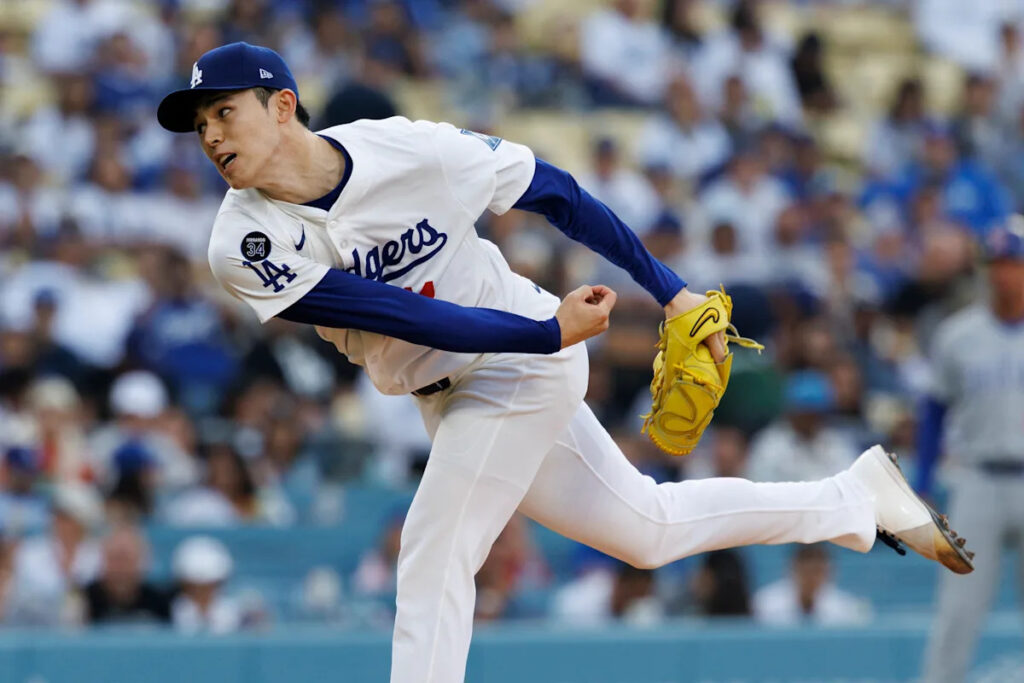
Over the weekend at Dodger Stadium, the highly anticipated rookie pitcher Roki Sasaki made his fourth start of the season, showcasing his best performance yet. Despite allowing just one run over five innings, the Dodgers suffered a 16-0 loss to the Cubs due to a lack of run support and a late-inning bullpen collapse. This marked Sasaki’s first loss in the big leagues, leaving him still in search of his first win as a starting pitcher.
While Sasaki is on a league-minimum contract like other rookie pitchers Jack Dreyer and Ben Casparius, the immense hype surrounding his debut has led to close scrutiny of his early outings. His development is being closely monitored, with comparisons to fellow teammate Yoshinobu Yamamoto, who required a significant monetary investment. After four starts, it’s clear that Sasaki’s performance is under the spotlight as he navigates his rookie season.
Let’s delve into what we’ve observed from Sasaki so far.
The stuff
In Japan, Sasaki primarily relied on a high-90s four-seam fastball, a mid-80s slider, and a devastating splitter in the 88-89 mph range. His pitch mix evolved during his time in NPB, with the splitter being his go-to secondary pitch. In his early MLB career, Sasaki’s fastball usage has increased, while his slider has taken a backseat. However, the velocity of his splitter and slider has slightly decreased compared to his time in Japan. It’s important to note that Sasaki is still adjusting to the MLB ball and facing more competitive hitters, which will impact the development of his pitch mix.
The results
Despite his high walk rate, Sasaki has managed to keep opponents in check with a 3.29 ERA. It’s clear that he needs to improve his control to be a successful starter in the long run. While his splitter has been effective, his fastball has not generated as many swings and misses. Developing his slider will be crucial to complement his splitter and improve overall effectiveness.
What’s next?
Sasaki’s upcoming starts against the Rangers and Pirates will provide further insight into his progress. Each start is an opportunity for him to refine his skills and adapt to the demands of MLB competition. As the season unfolds, Sasaki’s development will be key to the Dodgers’ success in a competitive NL West race.