
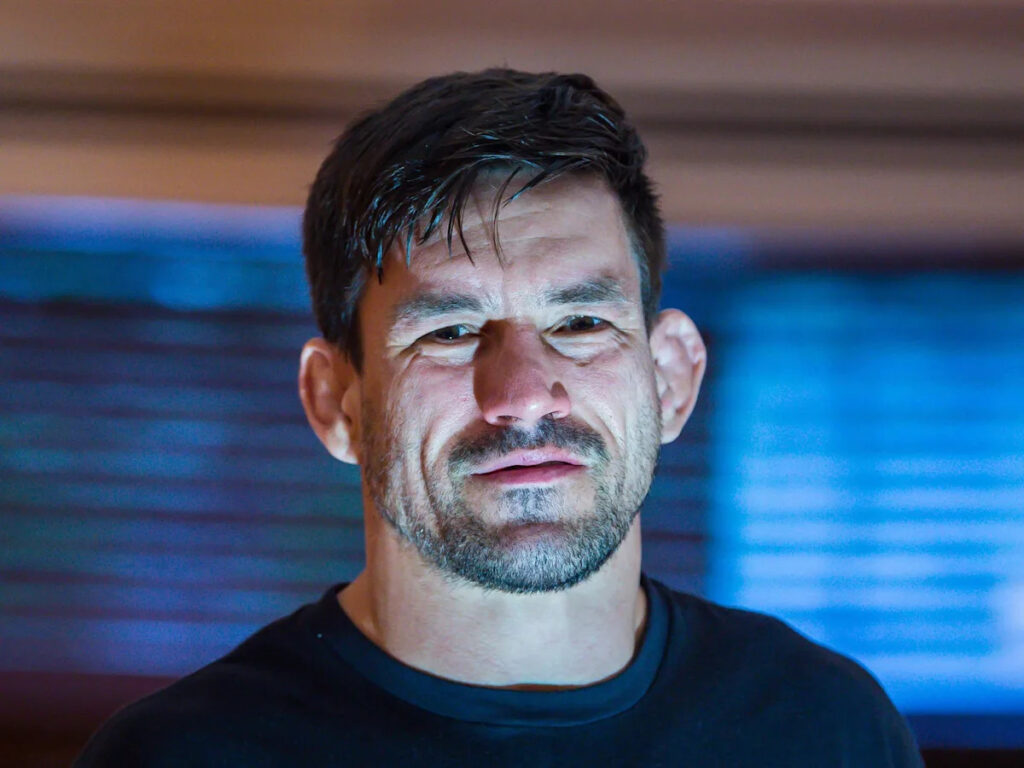
On Saturday night, if you were paying close attention, you may have spotted him. He was there in Ian Machado Garry’s corner, offering advice and fine-tuning the fighter’s game between rounds. He critiqued Garry’s use of the wrong half-guard and enhanced his transition game.
To truly understand the significance of this individual in the world of mixed martial arts, you would need some knowledge of the sport’s history. Alternatively, you could ask Reinier de Ridder, who will be facing Bo Nickal in the co-main event of Saturday’s UFC Fight Night in Des Moines, Iowa. De Ridder idolizes Demian Maia for his expertise in submission grappling adapted for MMA.
“It’s really just one guy, and that’s Demian Maia,” de Ridder shared with Uncrowned. “He’s the guy. You look at what he did, his creativity — he’s the one.”
Maia’s influence extends beyond de Ridder. Neil Magny, who was submitted by Maia at UFC 190, also expressed his admiration for Maia’s skills. Despite his initial confidence, Magny was humbled by Maia’s abilities on the ground and sought to reach a similar level of proficiency.
At 47, Maia continues to be revered by fellow fighters for his knowledge and experience. He now primarily serves as a coach and trainer, with fighters seeking his guidance for MMA-specific grappling techniques.
Maia’s approach to jiu-jitsu in MMA sets him apart from others in the sport. He has honed his skills over years of trial and error, adapting his game to suit the demands of the cage.
His journey in the UFC began in 2007, where he dominated the middleweight division with his submission prowess. However, setbacks against opponents like Nate Marquardt and Anderson Silva prompted Maia to enhance his striking abilities.
Recognizing the importance of transitions in MMA, Maia integrated his striking and grappling training to create a more well-rounded approach to fighting. This shift in strategy was evident after his loss to Chris Weidman in 2012, where he realized the need for a more comprehensive skill set.
Maia’s evolution as a fighter and coach showcases his commitment to adapting and improving in the ever-changing landscape of MMA. His expertise in blending jiu-jitsu with MMA-specific techniques continues to shape the careers of aspiring fighters.
During his career, Maia had a realization that changed the course of his fighting style. Despite his efforts to improve his striking game, he understood that his true strength lay in his ground game. His boxing skills had to exist but serve as a means to an end – transitioning to the ground where he excelled.
He adapted his training and mindset, focusing on boxing with clinches and takedowns. Maia emphasized the importance of knowing all opportunities in MMA, not just for himself but also for his opponents.
This shift led to a late-career resurgence for Maia. Moving to welterweight, he embarked on a winning streak and defeated notable opponents with his submission skills. Despite his predictable game plan, Maia continued to execute it successfully, earning a UFC title shot in a second division.
While his last fight in 2021 resulted in a loss, Maia transitioned into a coaching role, sharing his knowledge with the next generation of fighters. His innovative grappling techniques have inspired fighters like de Ridder to emulate his style.
Receiving recognition from younger fighters for his contributions to the sport brings Maia joy. He values the opportunity to pass on his knowledge and inspire others, just as his mentors did for him.
Today, Maia’s impact on the UFC is evident through the fighters he has influenced, and his journey is far from over.