
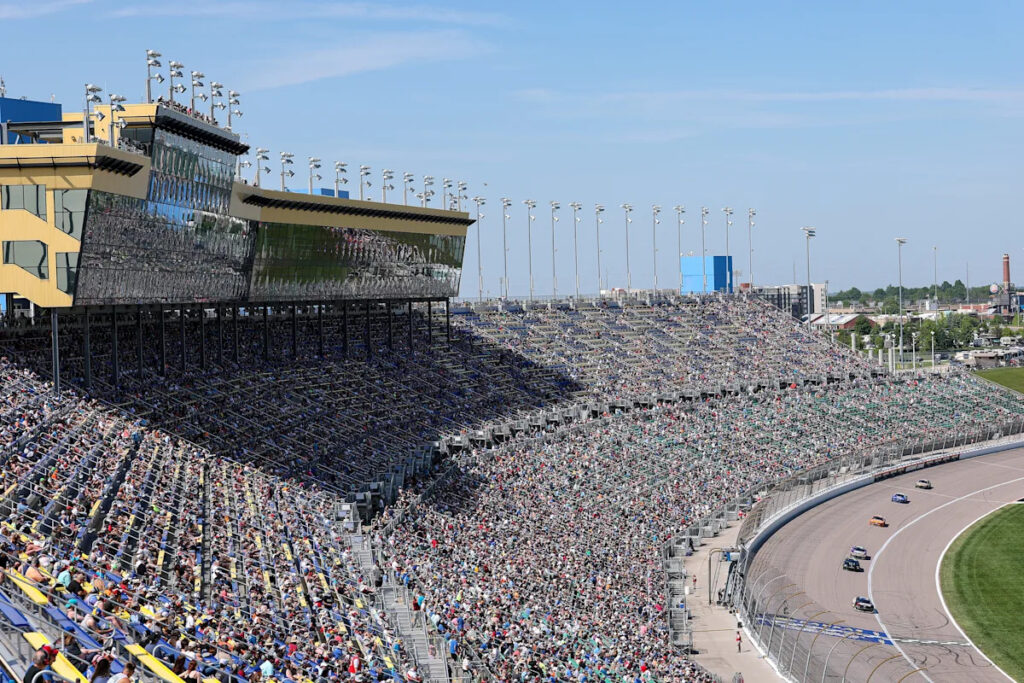
Kyle Larson’s victory at Kansas Speedway in front of a limited audience highlighted a significant challenge that NASCAR must address as it moves forward into the 2020s and beyond.
It is important to note that the issue does not stem from Larson’s exceptional performance and domination on Sunday. He claimed victory in all three stages and clearly had the fastest car, although there was some suspense on the final lap. Larson’s car decelerated suddenly on the last lap as he carefully guided it to the finish line less than a second ahead of Christopher Bell. If the race had been one lap longer, Larson might not have emerged as the winner.
However, the concern lies in the notably low attendance at Kansas Speedway to witness Larson secure his second consecutive spring win. After years of sold-out events in the 2000s and 2010s, the grandstands on Sunday were only about half full. Spectators had plenty of space to spread out, and if you looked closely, you could make out the words “Kansas Speedway” formed by the seats in the middle.
Kansas is NASCAR’s best track. Why weren’t more fans in attendance? (Photo by Jamie Squire/Getty Images)
(Jamie Squire via Getty Images)
Kansas Speedway is renowned as NASCAR’s premier track. The 1.5-mile oval’s surface has aged gracefully, providing excellent tire wear, while the progressive banking allows for multiple racing lines. Even on its worst days, it offers three racing lanes and can facilitate four or even five-wide racing immediately after restarts.
Just a year earlier, Larson narrowly defeated Chris Buescher in the closest finish in NASCAR history. He clinched victory by a mere 0.001 seconds after the initial timing and scoring data indicated that Buescher had crossed the finish line first.
Although the tight finish resulted from a restart with two laps remaining, it aptly showcased the remarkable racing at Kansas Speedway. If the track were situated a few hundred miles south, it would unquestionably be a prime candidate to host a championship race in early November, as NASCAR plans to rotate the location of its title races post-2026.
Yet, even if Kansas were to host a championship race, would fans turn out in larger numbers?
Promoting NASCAR’s top track should be a straightforward task. While Sunday’s race coincided with Mother’s Day and the peak of high school graduation season in Kansas City, there was minimal local buzz leading up to the event. NASCAR weekends used to be major attractions in this city but have recently felt like an afterthought.
This is not solely a Kansas City issue. NASCAR has significantly downsized its public relations efforts in recent years in a bid to cut costs. It is difficult not to draw a connection between these cutbacks and the lack of promotional activities.
Despite still being considered the leading motorsport in the United States, NASCAR faces challenges. Last week, the Cup Series race at Texas Motor Speedway directly competed with the Formula 1 Miami Grand Prix. The Cup race garnered more television viewers than the Miami Grand Prix on ABC, even though it aired on Fox Sports 1. However, the F1 race easily won the coveted 18-49 demographic in terms of both total viewers and share, with over a third of F1 viewers falling within that age bracket compared to less than 20% for NASCAR.
While it may be premature to suggest that NASCAR is in the midst of an existential crisis, the sport is not poised to return to the heights it reached two decades ago. If NASCAR struggles to fill the grandstands for its premier product, it raises questions about the overall health of the sport.