
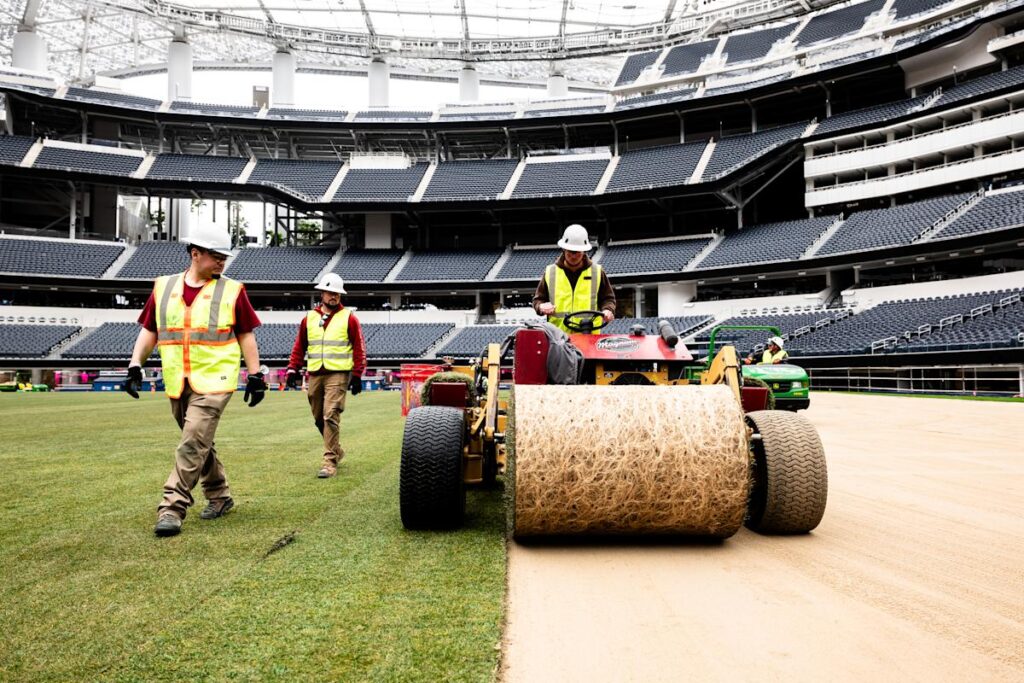
The refrigerated trucks will rumble down a thousand miles of highway, tracked by the minute and packed with rolls of the most precious grass in sports.
They’ll arrive at SoFi Stadium in Southern California, and at other NFL stadiums next June, on the home stretch of a years-long search for solutions to a 2026 World Cup problem: turf.
Seven of 11 U.S. venues have the artificial kind; but international soccer disdains it. So, as soccer’s crown jewel comes to North America, renowned professors, agronomists, engineers and construction workers are on a mission to replace synthetic surfaces with what one expert lovingly calls “some of the most micromanaged grass in the world.”
Their mission has spanned continents and universities, “shade houses” and sod farms, sun and artificial light. It has cost millions of dollars. It has spawned uncertainty and anxiety. But soon, organizers believe, it will help bring the World Cup to life.
Because it has yielded a plan — one that SoFi Stadium will pilot at the CONCACAF Nations League finals next week.
The plan is to weave artificial fibers into natural grass grown on plastic; lay this “hybrid” grass on an innovative Permavoid drainage layer; and fuse together a temporary pitch on par with the best of the English Premier League, as AT&T Stadium did last fall.
It will require “an army of people” and “a 24/7 operation”; computerized tractors and proprietary machinery; “exhaustive” testing and constant tweaks over the coming 15 months. It sounds, perhaps, a bit excessive.
But to FIFA, it’s of “the highest importance,” as World Cup chief Heimo Schirgi said. And it’s necessary, in part, because previous stateside soccer tournaments have been marred by fields that were “a disaster.”
The most recent major one, the 2024 Copa América, opened on a pitch that players said felt “like a trampoline.” Argentina defender Cristian Romero called the conditions at Mercedes-Benz Stadium in Atlanta “very ugly.” U.S. midfielder Weston McKennie, speaking the following day, expressed a sentiment shared by hundreds of pros who’ve visited NFL venues with makeshift mats for friendlies and other competitions: “It’s frustrating,” he said, to play “on a football field, with laid grass that’s all patchy, and it breaks up every step you take.”
That, in a nutshell, is the problem FIFA confronted when it chose the U.S., Canada and Mexico to host this World Cup. Eight of the 16 selected stadiums have artificial surfaces. Five have roofs. Some lacked underground infrastructure for ventilation and irrigation. “It’s really difficult,” says Adam Fullerton, Mercedes-Benz Stadium’s VP of operations, “to put grass in stadiums like this.”
So, over the past few years, at FIFA’s command, they’ve built that critical infrastructure. In consultation with researchers, they’ve developed novel schemes to grow and maintain grass indoors. As showtime looms, and dress rehearsals near, they’re confident in those schemes — but also nervous for one very simple reason.
“This,” says Otto Benedict, the SVP of facilities at SoFi Stadium, “hasn’t been done before.”
From turf or grass to ‘hybrids’
The search for solutions began, in earnest, back in 2019 at a familiar place. FIFA recruited John Sorochan and then Trey Rogers, turfgrass gurus at the University of Tennessee and Michigan State, who in 1994 had confronted a similar challenge for soccer’s global governing body: putting grass in the Pontiac Silverdome for North America’s last men’s World Cup.
Three decades later, they launched a multi-million dollar research project. They used the “shade house” at Tennessee to study indoor growing, and the asphalt pad at Michigan State to trial under-surface materials. They traveled the continent and the world, and used a patent-pending “fLEX” device — which simulates a cleated human foot hitting the grass, and measures the forces generated — to test “probably 125 stadiums,” including “several in England,” Sorochan says. That testing, plus thousands of other data points, allowed them to establish “corridors,” or benchmarks, for the “ideal pitch.” The home fields of Arsenal (Emirates Stadium) and Aston Villa (Villa Park) were deemed the gold standards.