
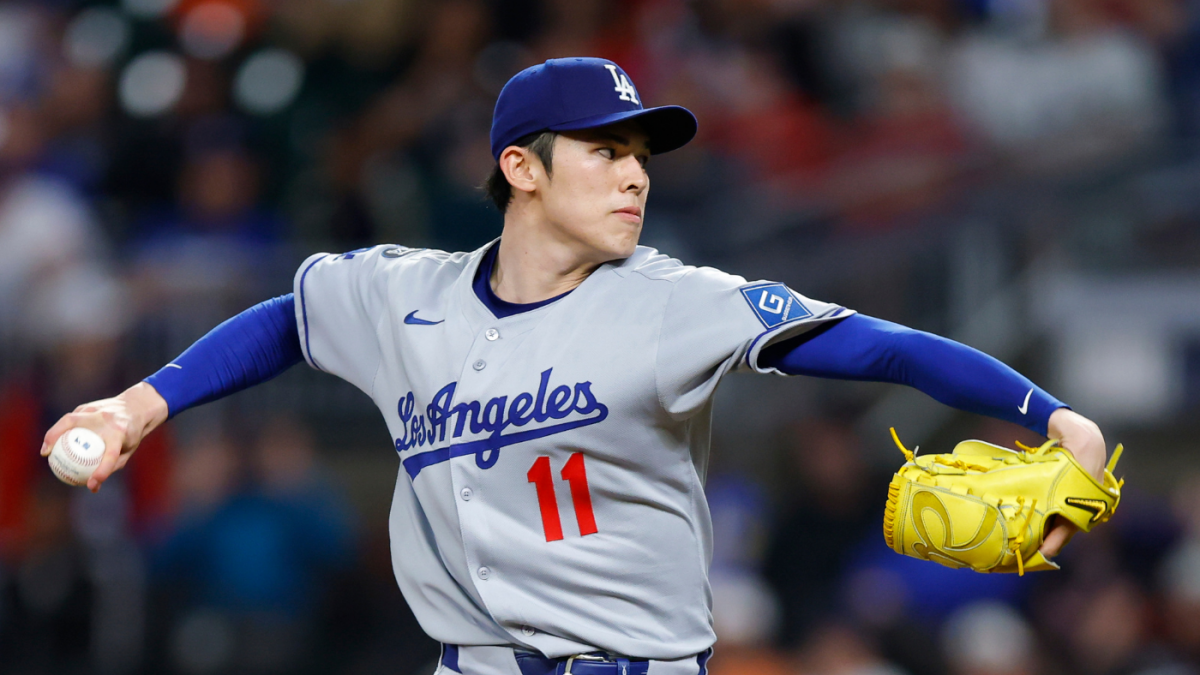
The first 20% of the 2025 MLB regular season is in the books and things are beginning to look normal, for lack of a better term. Only one qualified hitter (Aaron Judge) is hitting over .400 and just a handful of qualified starters have a sub-2.00 ERA. Contenders that started poorly are getting hot and pretenders that started well are coming back to Earth. Here now are three trends worth keeping an eye on as we head into the thick of May.
Sasaki’s not-so-great fastball
Saturday night in Atlanta, Dodgers righty Roki Sasaki earned his first MLB win with an outing that was OK but not really great. He allowed three runs on six hits and two walks in five innings, and struck out four. The offense put 10 runs on the board, including seven when Sasaki was in the game, which helped the 23-year-old righty record his first big-league W.
“Just really relieved and happy,” Sasaki said through an interpreter about getting his first win (via the Orange County Register). “I’m just relieved that I was able to do what I was supposed to do as a starting pitcher. Knowing the circumstances to which it was getting complicated as the (rain) delay was getting a little longer, and also knowing the fact that we were gonna play today.”
Seven starts into his Dodgers career, Sasaki has a 3.86 ERA and has put 44 runners on base in 30 ⅓ innings. The arm talent is obvious and the kid is electric, though like so many young pitchers, Sasaki’s had ups and downs early in his career. That includes walking 20 batters in those 30 ⅓ innings. Young pitchers walk too many hitters. It’s what they do.
The most surprising thing about Sasaki through seven starts (surprising to those who didn’t follow him closely in Japan, I should say) is that his fastball, while lighting up the radar gun, is pretty mediocre in terms of results. Sixty-eight pitchers have thrown at least 200 four-seam fastballs this season, and only one has a lower whiff rate (i.e. misses per swing) on the pitch than Sasaki:
- Antonio Senzatela, Rockies: 10.3%
- Roki Sasaki, Dodgers: 11.0%
- Mitch Keller, Pirates: 11.0%
- Jack Flaherty, Tigers: 11.3%
- Mitchell Parker, Nationals: 11.8%
(MLB average on four-seamers: 21.3%)
Sasaki’s fastball whiff rate is barely half the MLB average. Opponents are hitting .232 with a .406 slugging percentage against his four-seamer, which is better than the league average (.248 AVG and .424 SLG). That’s the average for all four-seamers though. If you look at 96 mph and above, like Sasaki’s heater, the MLB averages are .236 AVG and .405 SLG. Sasaki’s right there.
Despite the velocity, Sasaki’s fastball plays down because it has poor shape, meaning the movement characteristics of the pitch. The spin and rise on his fastball are unremarkable, making the pitch easier for hitters to track and time. Those pitch characteristics can be improved (and the Dodgers are very good at doing so), though it can take time, and sometimes things just do not click.
Also, Sasaki’s velocity is trending down. His fastball has sat closer to 94-96 mph the last three times out compared to 96-98 mph in his first few starts. Sasaki hit 100.6 mph against the Cubs in the Tokyo Series. He hasn’t throw a pitch above 98.6 mph since. Dodgers pitching coach Mark Prior indicated Sasaki is intentionally holding back on his fastball in an effort to locate better.
“Roki, everybody knows he throws 100,” Prior told The Athletic recently. “He’s not throwing 100 with us. That’s something that I think he was trying to train and get to it, which we tried to help as much as we could. But he also felt like it affected his command tremendously in those first couple outings.”
Prior also said the Dodgers and Sasaki are “kind of in bed with where we’re at” as far as his fastball shape, meaning they can only do so much in-season. Sasaki signed with the Dodgers on Jan. 22, or three weeks before spring training, give or take. That didn’t give them much time to work on things, especially with the team’s unusual ramp up to the Tokyo Series in mid-March.
There is more to life than fastball shape, but it is an important piece of the pie, and Sasaki’s underwhelms. Still, his slider and splitter are so good that he has more than enough to get by. It is likely the best version of Sasaki is a year or two (or three) away, after he can spend a proper offseason working with the Dodgers. What he is right now is still pretty good, albeit not elite.
Walker’s improved defense
In his third MLB season, the Cardinals are still waiting for erstwhile top prospect Jordan Walker to launch offensively. The soon-to-be 23-year-old took a .198/.261/.274 line into Tuesday’s game. His production has slipped and his strikeout rate has climbed since his debut in 2023. Walker’s exit velocities are very good, but a propensity for ground balls and pop ups mute his production.
I think it’s fair to say Walker’s offensive trajectory is discouraging. His defense, however, has been on the upswing. A third baseman in the minors, Walker moved to the outfield in the second half of 2022 because he wasn’t going to unseat Nolan Arenado at the hot corner, and also because he’s a big dude (6-foot-6 and 250 pounds) who wasn’t likely to stay at third long-term anyway.
Not surprisingly, Walker’s outfield defense rated poorly initially. He was a liability.
Walker has shown significant improvement as a defender as he has gained more experience. His defensive stats have been on the rise over the past few years, indicating his progress in the outfield. The numbers align with the visual assessment of his performance, as he appears more confident and refined in his fielding.
Initially splitting time between left and right fields in 2023, Walker has transitioned to playing exclusively in right field in the last two years. His strong arm in right field has become a valuable asset for the Cardinals. Despite his size, Walker possesses speed and athleticism reminiscent of players like Aaron Judge and Oneil Cruz. His improved speed allows him to cover more ground, while his improved instincts and decision-making show his growth in the position.
Walker himself acknowledges the progress he has made, particularly in his reads and overall confidence in the outfield. He emphasizes the importance of quick reactions and eliminating hesitation to make plays effectively. While his defensive improvement is commendable, Walker’s offensive development will ultimately define his career. It is crucial for him to excel offensively to complement his solid defensive skills.
In the broader context of the 2025 MLB season, home teams have enjoyed a significant advantage in winning games. The winning percentage for home teams is notably higher than in previous seasons, with some teams demonstrating exceptional success on their home turf. However, the overall trend seems to be balancing out as the season progresses, suggesting that the advantage of playing at home may normalize over time.
In conclusion, Walker’s evolution as a defender and the prevailing home-field advantage in the 2025 MLB season highlight the dynamic and competitive nature of baseball. As players like Walker continue to refine their skills and adapt to the game’s nuances, the sport’s unpredictability and excitement remain constant. text to make it more concise:
“Please rewrite the text to be more concise.”