
Major League Baseball’s regular season is now more than a month old, making this the time of the year when people begin to contemplate players’ statistics with more seriousness. Granted, the samples remain small. But, whenever a player’s output greatly deviates from expectations for this long, it’s only natural that folks start wondering what, precisely, is going on.
To honor that curiosity, I’m breaking down five pitchers who are playing better or worse than expected — on the rise or under the tide. I’ve attempted to explain the player’s performance to date, but, just as importantly, I’ve issued a verdict on what to expect from them heading forward.
With all that fine print out of the way, let’s get to business.
Pitchers on the rise
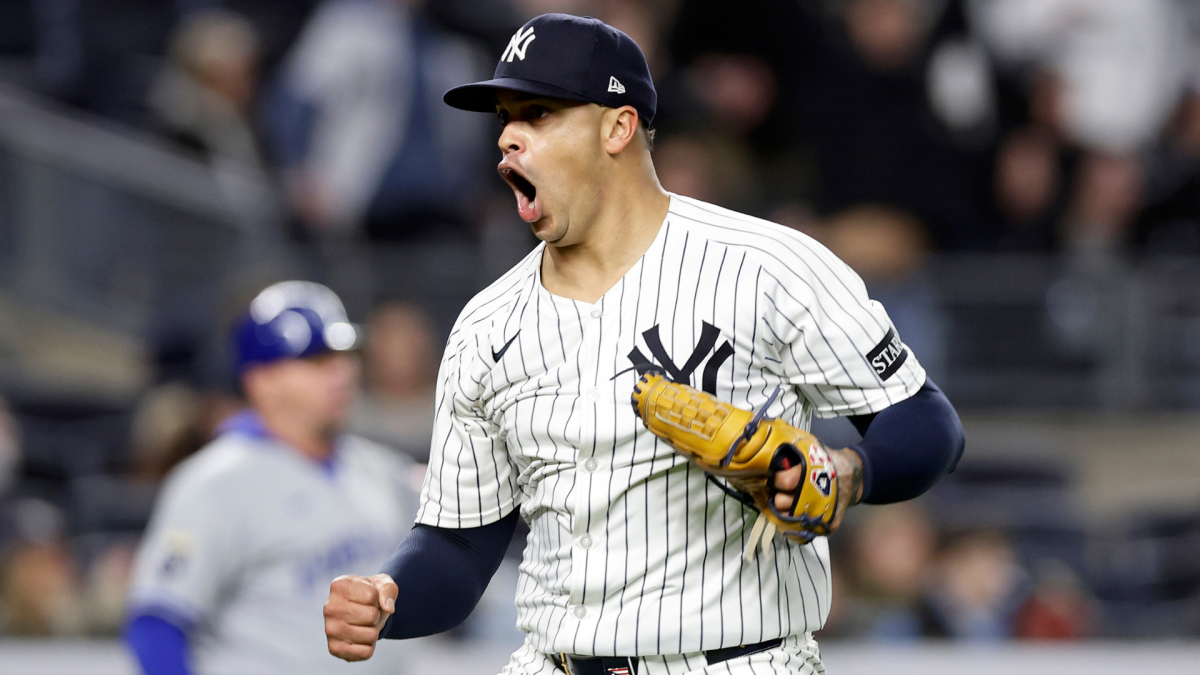
1. Fernando Cruz, RHP, New York Yankees
It’s not often that I include a 35-year-old in my breakout players column. I made an exception for Cruz, who entered the season with a career 4.52 ERA (100 ERA+) in 141 big-league appearances. You may recall that the Yankees nabbed Cruz from the Cincinnati Reds as part of the trade that sent catcher Jose Trevino to the midwest.
Cruz’s change of scenery encouraged me, since I felt the Yankees likely had some alterations in mind when they executed the deal. Here’s part of what I wrote back in February:
I have to imagine the Yankees are going to have Cruz ditch his ineffective cutter, the pitch responsible for nine of his 15 home runs allowed the last two seasons. Simultaneously, I expect Cruz to ramp up the usage of his splitter, in the spirit of how the Yankees had Tommy Kahnle spam his changeup. (Said splitter has held opponents to a .353 OPS over the last two years.) Should those tweaks occur, Cruz could emerge as a high-leverage weapon for Aaron Boone and the defending American League champs.
The Yankees did indeed see the same issues I identified, with Cruz making the exact tweaks I thought he might: spamming the splitter (56.4% usage rate) and seldom throwing the slider. In turn, he’s sporting a 1.45 ERA (278 ERA+) through 15 appearances.
While it’s never wise to read too much into a reliever’s statline after a month-plus of the season, I’ve been and remain a believer in Cruz as a viable high-leverage arm. His marks will likely regress to some extent, but I think this new formula will keep him in Boone’s circle of trust.
2. Matthew Liberatore, LHP, St. Louis Cardinals
Liberatore was the main piece the Cardinals received in the Randy Arozarena trade more than five years ago. You can be forgiven if it feels like more time has passed. After all, Arozarena enjoyed a successful run with the Rays before being traded, again, last deadline to the Seattle Mariners. Everyone has long since declared the deal a bust for the Cardinals, but the inconvenient truth is that the trade may still pay serious dividends for St. Louis. Be that from Tink Hence, the pitcher they selected with the draft pick they gained in the swap, or yes, from the southpaw de jour.
Liberatore won a rotation spot this spring after spending most of last year in the bullpen. He’s since entrenched himself by posting a 123 ERA+ and a 10 strikeout-to-walk ratio and averaging nearly six innings per pop across his first six starts. Furthermore, his 0.6 Wins Above Replacement is more than he had tallied over the course of his initial 91 big-league appearances.
The main difference in Liberatore’s game this year is that he’s prioritized using his slider as his go-to offering. It’s his best pitch at generating swings and misses, and he’s comfortable using it against lefties and righties alike. Otherwise? Liberatore’s success can be credited to his control over a slew of average or worse pitches, including two kinds of fastballs and a cutter.
Is Liberatore going to continue to front the Cardinals rotation? No, I wouldn’t think so. But a lefty who can throw strikes with a broad arsenal is never going to want for opportunity.
3. Max Meyer, RHP, Miami Marlins
Meyer was a personal favorite entering the 2020 draft: a small, athletic right-hander from Minnesota with a devastating slider. He’s since dealt with his share of injuries and setbacks, limiting him to 13 big-league appearances over his first four-plus years as a professional. He’s making up for lost time thus far this season, tallying a 114 ERA+ and a 3.62 strikeout-to-walk ratio over the course of his first seven times through the rotation.
Meyer is clearly a different pitcher now than he was even last season. Three of his pitches (his four-seamer, sinker, and changeup) have significantly altered shapes and added velocity, and he’s introduced a sweeper that offers even more gloveside movement than his signature slider. He’s using five pitches at least 10% of the time, giving him more looks to throw at the opposition than he did previously, when he was predominantly a fastball-slider pitcher with an occasional change.
For as good as that sounds, you might wonder if there’s reason for concern about Meyer’s propensity for allowing loud contact — he ranks in the 14th percentile in hard-hit percentage. I do find it reassuring that said contact tends to happen outside of the proverbial danger zone. Put another way, no pitcher surrenders a lower percentage of their 95 mph-plus batted balls within the 10 to 30 degree window than Meyer does. It’s to be seen if that holds up, but he has plenty working in his favor and I’d like to think that he’ll continue to be an above-average starter.
Pitchers under the tide
4.
Tanner Houck, a right-handed pitcher for the Boston Red Sox, is having a challenging season compared to last year. In 2024, he only gave up 11 home runs in 178 ⅔ innings, while this season he has already allowed seven home runs in just 36 ⅔ innings. This significant increase in home runs is a cause for concern, especially considering his exceptional performance last year.
Houck’s secondary pitches, specifically his sweeper and splitter, have been less effective this season due to poor location. Interestingly, he has reintroduced a four-seamer to his arsenal this year after not using it in the previous season. Additionally, he has phased out a cutter that was an important part of his pitching strategy in 2023.
Despite his struggles, it is expected that Houck will make necessary adjustments and improve his performance. While he may not reach All-Star level status again this season, he is unlikely to remain one of the worst pitchers in the league.
On the other hand, Dylan Cease, a right-handed pitcher for the San Diego Padres, is also facing challenges at the start of his platform year. His performance has been below expectations, with a higher walk rate and a lower strikeout rate compared to previous seasons.
Cease has made adjustments to his pitching mechanics, including lowering his arm angle, which has affected the movement of his pitches. He is also struggling to locate his curveball effectively, leading to a decrease in strikes thrown with that pitch.
Despite these difficulties, Cease’s underlying measures are similar to last season in many aspects. With some corrections and improvements, it is likely that Cease will bounce back from his slow start and perform better as the season progresses. following sentence:
The dog ran quickly through the park.
The dog sprinted through the park with great speed.